
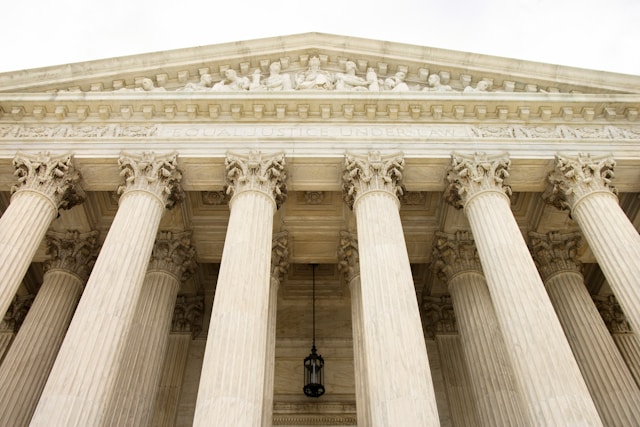

The U.S. Supreme Court is hearing oral arguments in a high-stakes copyright dispute that could significantly affect the liability of internet service providers (“ISPs”) for third-party online infringement.
At issue in Cox Communications, Inc. v. Sony Music Entertainment, Inc. is whether an ISP can be held contributorily liable for copyright infringement when it continues to provide internet access to subscribers after receiving repeated notices of infringing activity.
The outcome of this case, expected by mid-2026, may reshape copyright enforcement in the digital age.
Factual and Procedural Background
The case stems from a lawsuit originally filed in 2018 by a coalition of major music labels—including Sony Music, Universal Music Group, and Warner Music Group—against Cox Communications, a large U.S. internet service provider. The labels alleged that Cox repeatedly failed to take meaningful action against subscribers who engaged in widespread unauthorized sharing of copyrighted music via peer-to-peer networks, despite receiving detailed infringement notices identifying specific IP addresses.
In 2019, a federal jury in Virginia found Cox liable for both contributory and vicarious copyright infringement and awarded more than $1 billion in statutory damages. On appeal, the U.S. Court of Appeals for the Fourth Circuit affirmed the finding of contributory liability based on Cox’s continued provision of service to known infringers but reversed the vicarious liability finding and vacated the damages award. The Fourth Circuit subsequently remanded for a new damages trial and rejected Cox’s safe-harbor defense under the Digital Millennium Copyright Act (DMCA) due to inadequate termination of repeat infringers. Cox filed a petition for certiorari, and the Supreme Court granted review, focusing on questions of contributory liability and willfulness under the Copyright Act.
Core Legal Issues Before the Supreme Court
The primary legal issues before the Court are whether an ISP that continues to provide internet access to particular subscribers after being notified of their infringing behavior can be held liable for contributory copyright infringement, and whether willfulness under 17 U.S.C. § 504(c)(2) may be established by knowledge of the infringing conduct of others without knowledge that the ISP’s own conduct is unlawful.
Cox argues that providing internet access, without more, does not constitute material contribution to infringement and that imposing liability on that basis would effectively transform internet service providers into copyright enforcers. The company warned that, absent a restrictive rule, ISPs might be forced to terminate service for entire households, institutions, or communities merely because a user allegedly engaged in infringing conduct on the same connection.
Opposing this, the music industry plaintiffs contend that Cox’s failure to act on repeated infringement notices exceeded the protections of the DMCA and that Cox materially contributed to infringement by knowingly allowing infringing conduct to continue unabated. They argue that the ISP’s specific knowledge and inadequate response justify holding it responsible for the harm caused by its subscribers.
Oral Argument Themes and Justices’ Questions
During oral arguments in December, the Supreme Court justices probed both sides on the proper standard for secondary liability in the digital context. Some justices expressed skepticism of Cox’s position that mere awareness of infringement should shield it from liability, noting that such a rule could render statutory safeguards like the DMCA safe harbor superfluous. Other justices raised concerns about imposing liability in ways that might disrupt internet access for innocent users who share connections with alleged infringers.
Justice Sotomayor, for example, questioned how an ISP should balance compliance with practical realities, analogizing the facts to traditional aiding and abetting scenarios. At the same time, other members of the Court sought clarification on the degree of affirmative conduct necessary to establish contributory liability.
Broader Implications of the Decision
The Supreme Court’s eventual decision in Cox Communications v. Sony Music Entertainment is poised to influence the legal framework governing intermediary liability for online infringement, with potential ramifications for internet service providers, online platforms, and content owners. A ruling favoring the music industry could expand the circumstances under which ISPs and similar intermediaries may face liability for user conduct, while a decision for Cox could reinforce limitations on contributory infringement exposure and clarify the interplay between the Copyright Act and the DMCA safe harbor.
For practitioners in media, technology, and intellectual property law, the case underscores the ongoing tension between protecting copyrighted works and maintaining open access to digital networks. The Supreme Court is expected to issue its decision by June 2026, which will provide much-anticipated guidance on these foundational issues in internet and copyright law.
As the Supreme Court considers a decision that could fundamentally reshape copyright enforcement and intermediary liability, businesses operating in media, technology, telecommunications, and digital platforms should be proactively assessing their risk exposure and compliance strategies. Romano Law advises clients on navigating complex copyright disputes, DMCA safe-harbor compliance, and emerging liability standards for online intermediaries.
If your organization is facing infringement claims, developing repeat-infringer policies, or seeking guidance on mitigating litigation risk in light of this case, we invite you to contact us to discuss how our experienced legal team can help protect your interests in an evolving digital landscape.
Contributions to this blog by Kennedy McKinney.